
The History of Adult Dating Sites in Argentina
The History of Adult Dating Sites in Argentina
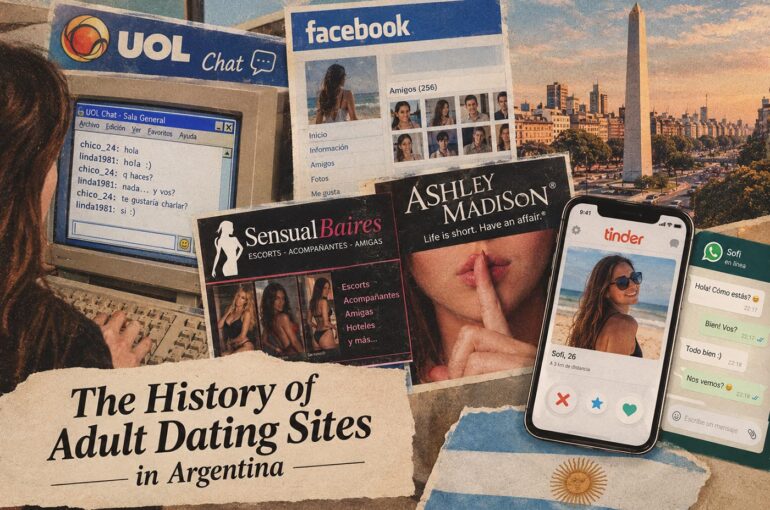
Long before dating apps turned meeting someone into a matter of swiping left or right, Argentines were already using the internet to flirt, make contacts, arrange dates, visit escorts and, sometimes, look for encounters that would have been difficult to organize through traditional social circles.
The history of adult dating in Argentina is therefore closely connected to the history of the Argentine internet itself. It began with anonymous chat rooms and classified advertisements, moved into forums and social networks, became more specialized with sites dedicated to affairs, and eventually became almost entirely mobile and location-based.
What changed over the years was not necessarily the desire to meet someone. What changed was the mechanism for finding them.
The late 1990s: when the internet first became a meeting place
In Argentina, the first generation of online encounters developed during the era of dial-up connections. Internet access was slow, expensive and usually tied to a desktop computer, but that did not prevent people from experimenting with the possibilities.
Chat rooms were among the first places where strangers could meet.
Portals such as Ciudad.com.ar, Terra, Clarín and Arnet offered chat rooms where users could enter under nicknames and communicate with people they had never met. ICQ and, later, MSN Messenger provided more private forms of conversation. These platforms weren’t specifically designed for dating, but flirting quickly became one of their obvious uses.
The anonymity was particularly important. A person could enter a room without necessarily revealing their real name, photograph or social background. Someone who might never approach a stranger in a bar could simply type “hola” into a chat window.
That was a fundamental change.
The internet did not invent anonymous encounters, of course. What it did was make them scalable.
Instead of meeting someone through friends, work, university, a nightclub or the neighborhood, an Argentine user could suddenly communicate with dozens or hundreds of strangers.
And very quickly, the commercial side of adult encounters discovered the same technology.
The first Argentine adult websites
By the end of the 1990s, Argentina already had websites specifically dedicated to adult classifieds and escort advertising.
A 1999 report in La Nación described at least half a dozen Argentine websites publishing advertisements from people offering sexual services. The advertisements could include photographs, telephone numbers and descriptions, effectively turning the internet into a new kind of classified section.
This was an important distinction from chat rooms.
Chat was primarily about conversation and discovery. Adult websites were increasingly about presentation and availability.
A person could create an advertisement, add photographs and contact information, and potentially be found by someone searching specifically for that type of encounter.
In other words, the internet was beginning to separate adult dating into different categories: social interaction, casual encounters, commercial companionship and relationships.
One of the names associated with this early period was SensualBaires.
By 2003, Página/12 described SensualBaires as a major Argentine adult website, offering sections for escorts and different types of adult companionship alongside other content. The newspaper reported substantial traffic and described how some visitors used the site specifically to turn online searches into real-world meetings.
The significance of sites like SensualBaires was not simply that they put adult advertisements online. They created an early version of what would later become standard on dating apps: profiles, photographs, preferences and direct contact between strangers.
The interface was primitive by today’s standards, but the basic idea was already there.
The 2000s: MSN, forums and the social internet
During the first half of the 2000s, Argentines increasingly moved from public chat rooms toward private communication.
MSN Messenger became particularly important. Users exchanged email addresses, added each other to contact lists and communicated privately. A flirtation that started in a chat room could quickly migrate to MSN.
The distinction between “dating website” and “social website” was therefore often blurry.
Fotolog, MySpace, forums and other communities gave people opportunities to display photographs and interact with strangers. The technology was still largely desktop-based, but the culture was moving toward something that would eventually look very familiar: a profile photograph became an essential part of online attraction.
This was also the period when online dating gradually lost some of its association with computer enthusiasts.
People no longer needed to understand IRC, install complicated software or spend hours navigating obscure websites. The internet was becoming a normal part of everyday Argentine life.
Then came Facebook.
Facebook changes everything
Facebook opened to the general public internationally in September 2006, and it became increasingly established in Argentina during the following years. An Argentine educational resource describing the country’s social-media development places Facebook’s arrival and expansion around 2007–2008, with more than six million active users reported by 2011.
Facebook wasn’t an adult dating site.
That was precisely what made it so influential.
For the first time, huge numbers of Argentines had a persistent online identity containing a name, photograph, friends, interests and personal information. People could find someone they had met at a party, reconnect with an old acquaintance or become friends with a stranger through mutual contacts.
Flirting became integrated into ordinary social networking.
Instead of entering a website explicitly labeled “dating,” someone could simply send a friend request.
From there, the familiar sequence began: comments, private messages, photographs, late-night conversations and eventually a meeting.
Facebook also made online identities less anonymous. This was both an advantage and a limitation. A real profile could make a potential contact seem more trustworthy, but it also meant that discretion became more difficult.
For people looking specifically for extramarital encounters, that created demand for something different.
Ashley Madison and the specialized dating market
That gap was filled dramatically in 2012 when Ashley Madison officially launched in Argentina.
The Canadian company, founded in 2002, specialized in connecting people who were already married or in relationships and were looking for extramarital encounters. When it launched locally, the company said it already had more than 72,000 registered Argentine members, with 61% located in the Buenos Aires metropolitan area.
Other specialized services appeared around the same time. Second Love, for example, arrived in Argentina in 2012 and was reported to have tens of thousands of local users. These platforms emphasized privacy and anonymity rather than the public identity associated with Facebook.
This was an important development because the market was becoming segmented.
There were now different reasons to use the internet to meet people:
- finding a conventional romantic partner;
- making new friends;
- looking for casual encounters;
- maintaining discreet relationships;
- searching for adult companionship;
- and arranging commercial encounters.
The internet was no longer simply a place where people happened to flirt. It had become an infrastructure for different kinds of relationships.
The smartphone revolution
The next major transformation came from smartphones.
Before smartphones, online dating required sitting in front of a computer. After smartphones, the dating service was effectively carried in someone’s pocket all day.
Tinder was particularly important.
The application launched internationally in 2012 and became established in Argentina around the end of 2013 and beginning of 2014. By March 2014, reports put its Argentine user base at around 400,000 profiles.
Its revolutionary feature was not simply that it was an app.
It was geolocation combined with photographs and extremely simple decisions.
Instead of searching through pages of classified advertisements, users were shown people nearby. A swipe indicated interest or rejection, and a mutual choice created a “match” that opened a private conversation.
Tinder effectively transformed dating into a continuous stream of possibilities.
By 2015, the company reported more than 2.5 million matches in Argentina, making the country one of its most active markets in Latin America at the time.
And although Tinder marketed itself as a dating application rather than an “adult” platform, Argentines quickly used it for a wide variety of purposes.
Some users wanted relationships.
Others wanted something casual.
Others were simply curious.
And some were already in relationships.
The boundaries between traditional dating and adult dating consequently became increasingly difficult to define.
From websites to ecosystems
During the second half of the 2010s, the Argentine dating market became increasingly fragmented.
Tinder was joined by applications such as Badoo, Happn, Bumble and Grindr, among others. Different platforms developed different reputations and user communities.
Location became more important than ever.
A traditional classified advertisement might tell you that someone was available in Buenos Aires. A modern app could tell you that someone was potentially within a few blocks.
That dramatically reduced the friction involved in making contact.
Messaging also changed. WhatsApp became the natural continuation of conversations that began elsewhere. A dating profile might lead to a match, the match to an exchange of messages, and the conversation eventually to WhatsApp.
The dating platform increasingly became the introduction, rather than the complete experience.
The 2020s: dating becomes completely mobile
The COVID-19 pandemic accelerated digital communication around the world, including dating.
Video calls, messaging and dating apps became increasingly normal ways of interacting with strangers before meeting in person. At the same time, the distinction between dating platforms and broader social media continued to disappear.
Today, Argentina has a mature dating-app ecosystem.
Argentina’s government currently lists Tinder, Grindr, Bumble, Happn, Facebook Dating, Badoo, Match, OkCupid, Hinge and other services among dating applications available to users.
Recent market data also illustrates the scale of the transformation. Sensor Tower estimated roughly 790,000 weekly active Tinder users in Argentina at the end of the first quarter of 2024, alongside hundreds of thousands of users across Badoo, Happn, Bumble and Grindr.
The numbers should not be interpreted as unique individuals—different measurement systems and multiple-account usage make direct comparisons difficult—but they demonstrate how far the country has moved from the days of dial-up chat rooms.
What actually changed?
Looking at the entire history, the evolution is surprisingly logical.
The first stage was anonymity.
Chat rooms allowed people to experiment with identities and talk to strangers without necessarily revealing much about themselves.
The second stage was presentation.
Adult websites and classified services introduced photographs, descriptions and contact information. People could actively advertise themselves or search for others.
The third stage was identity.
Facebook and other social networks connected online profiles with real-world social networks.
The fourth stage was specialization.
Ashley Madison, Second Love and other services demonstrated that different types of relationships could support their own platforms.
The fifth stage was geolocation.
Tinder and similar applications made physical proximity one of the most important variables in finding another person.
And finally came the smartphone ecosystem, where dating, messaging, photographs, payments and location services all coexist on the same device.
The journey from UOL-style chat rooms to today’s apps is therefore more than a technological story. It is a story about reducing the distance between wanting to meet someone and actually finding someone.
In the late 1990s, an Argentine might enter a chat room and wonder who was on the other side of the screen.
In the 2000s, they could see a photograph and add that person to MSN or Facebook.
By the early 2010s, specialized websites could help them find people looking for very specific types of encounters.
By the middle of the decade, a smartphone could display nearby possibilities in seconds.
And today, the entire process—from discovering someone to exchanging messages and arranging a meeting—can happen without ever leaving a phone.
The technology has changed enormously. The basic human curiosity behind it has remained remarkably consistent.